woensdag 20 juni 2012

EK Interview: Anton Kusters


When he ventured out on his journey to Japan, I am not sure Anton knew what the impact of his account would be, or how wanted his photographs including his tale would become.
There are however few photographers who have the courage to go as far as he did.
He showed us what we all wanted to see, and that's the essence of photography.
Photography is not about taking beautiful pictures, it's about telling a tale.
Uschi Lichter, Linkerpoot photography
20-06-2012

By  - May 24, 2012
art blog - Anton Kusters - empty kingdom
Anton Kusters is a badass, a humble and super down to earth badass but really, there is no better kind. To me, he is an anthropologist expressing his research through photography. He was featured on September 16, 2011 as well as on our EK Top 100 Artists of 2011, for his epic two year project with the Yakuza and he is back now to give us an exclusive on what was going through his mind in taking on a project of such caliber as well as other projects he’s got cookin’.
art blog - Anton Kusters - empty kingdom
1. Can you give me a brief self-introduction? Who are you and what does photography mean to you?
I guess photography to me is the most recent way I feel I can communicate what’s inside. I feel my abilities to visually express myself are still very crude, and that I have a lot to learn. I hope I get the chance to learn and become more proficient in photography and visual arts… And hopefully there will be many stories inside me to tell. The everlasting journey of always learning and growing as a human being thanks to photography, is for me the key to it all.
art blog - Anton Kusters - empty kingdom
2. In reference to your project Dislocate, can you tell me about the first image that made you feel like a photographer? What is the project about?
Those first images have more to do with the state of mind I was in at that moment, than the actual content of images themselves. More than anything, they depict a mood, they “marked” that moment for me when I felt that I should go for it. The scariest moments always seem to be the ones right before you jump into the unknown.
Dislocate is me looking for my roots. And by extension everybody else’s roots also. Who I am, where I belong. Why I am. What I feel and why I feel it. It forces me to open my eyes and my mind as wide as i can. It makes me not judge others and listen instead; it makes me try to understand. I believe it might even make me a better person. “Dislocate” is my sense of my place in this world, between my fellow human beings. Me feeling uprooted, my incessant looking for where I might belong… Where my land is. As a kid, my family moved around a lot, so much so, that I don’t seem to have the same feeling towards my birth place as many others have. It sets you free but at the same time seems to give you no real home.
art blog - Anton Kusters - empty kingdom
3. Apart from Dislocate, what can you tell us about your background that has influenced your work?
Family, travel, music and books, and close friends around me are all a continuous source of inspiration that never seize to amaze me. Also studying at university was instrumental in my life. I didn’t realize it at the time, but that level of education and that intense social interaction taught me many life lessons as an 18, 19, 20 year old, how to think and how to understand what I am thinking, how to place things in contexts I never knew even existed.
These days, I get influenced a million times a day by things happening around me, to me, with me, without me… making me nervous, happy, sad, pushing me to go ahead, sometimes stopping me in my tracks. Of course at the same time I follow as many fellow photographers, writers, sculptors, painters, and visual artists as I humanly can. They too, influence me, but on a different level. For me, understanding and accepting all these influences is an important thing to be able to learn and grow.
art blog - Anton Kusters - empty kingdom
4. What is Heavens about? What enticed you to do it and how do you plan on executing it?
Heavens is again such a hard project… I honestly don’t know if can describe it adequately just yet… It is about injustice, violence, realizing, burden, memory, all of it.
Heavens is focused on the Holocaust. The story my grandfather once told me when he was still around, about his home being raided during the war by Nazis looking to deport him, started it all. He was incredibly lucky and managed not to get caught that night, but was forced as a teenager to remain in hiding for the rest of the war.
Heavens is in the process right now of being shaped. The current idea is an extremely conceptual photographic one, to go and photograph the heavens above every single Nazi concentration camp that existed in WWII, because I believe that those little pieces of those heavens should belong to the people who suffered and died below there. It is most probably the last thing they saw. Those pieces of heaven should be theirs. The combination of all these heavens into one huge conceptual art installation will be the result of an inner reduction process. I know it’s an artistic break away from my previous work, but I feel at the same time that that thought shouldn’t constrain me.
When I found out that there were approximately 1,634 concentration camps spread out through entire Europe during WWII, Heavens suddenly became catapulted onto a different logistical scale all together. A scale that might even prove to be impossible to achieve.
Heavens now requires much contemplation, more shaping, to do it justice in the best way I can possibly achieve. I hope I will succeed, so that we may never forget.
art blog - Anton Kusters - empty kingdom
5. Tell us about your project with the Yakuza. What were you trying to get from your experience with them and do you feel you achieved your goal?
With the project YAKUZA I tried to understand what it was like to be a Yakuza member, to be one part inside the Japanese society, and one part outside, and the internal struggle that accompanies that position.
I learned that many Yakuza regard “being Yakuza” a way of life more than the violent actions that are attributed to that way of life. They feel that they must instill certain (what we would consider both morally bad and good) values upon the young who join their way of life, and that they have a certain role in Japanese society. While the fact that they often resort to violence in many forms, to me, is a morally wrong thing to do, yet those actions always seemed to be very framed and reasoned within their way of life.
My goal was to understand a little bit more about the Yakuza, and documenting my journey along the way. In that, I feel I have succeeded. On the other hand, in understanding the Yakuza subculture, I feel have only scratched the surface; even after the privileged access for several years, I understand now more than ever that I’ll never understand.
I learned that their world is more shades of grey than I can possibly imagine, as opposed to a simple black vs. white.
art blog - Anton Kusters - empty kingdom
6. What were your initial feelings going into the project? Did those feelings change as the project came to a close?
I guess I mainly learned not to be too nervous:-)
My main feelings changed very quickly in the beginning of the project, my brother and I kind of expected to be catapulted into a world with violence all over the place, but this quickly proved to be very different, very much more subtle and organized. This did not make it less scary, this unspoken, under the skin tension was present and palpable at all times and made us walk on eggshells literally all the time, constantly having to be aware of our surroundings.
art blog - Anton Kusters - empty kingdom
7. How did the images you captured change during the progression of your two year period? How did your photography skills evolve?
Photographically I learned a lot about low-light photography, as usually everything happened at night in the centre of Tokyo under neon lighting. I’m sure my images and view on my own photography must have changed and evolved during the two years of photographing, but to be honest I don’t know how exactly. It does seem now that I photograph less often, yet in longer bursts when I see something.
8. During your time with the Yakuza, how did you cope with being witness to situations where you may have been uncomfortable or morally conflicted?
In a way, I felt lucky that I was never part of documenting any outright violence, because I feel that would be morally impossible for me to photograph. Other than that, I tried to keep an as open mind as possible, reminding myselt that I am documenting what I myself feel in those situations. So in a way, the act of making images has been precisely my way of coping with all this.
art blog - Anton Kusters - empty kingdom
9. You are essentially documenting cultural and traditional rituals within an infamous organization that are both ambiguous and speculative to outsiders. Did you feel that you were documenting something momentous as you were taking these images?
I don’t know if “momentous” would be the right word to describe what I felt while I was documenting, as I was completely focused on every situation at that moment. I remember very often feeling lucky to be a privileged onlooker to incredible situations like the covert training camp or the funeral. I always felt that the Yakuza was unique culture/subculture that I was privileged to bear witness to.
art blog - Anton Kusters - empty kingdom
10. Organized crime is an enigmatic culture, the truth behind most of the way they relate or function with each other is largely a mystery to outsiders; did you feel you walked away with a new outlook? How does your experience compare to the pop culture idea of what the mafia is?
I walked away with an initial view of black versus white that had changed into a view of many many shades of gray. As usual, the conclusion is that popular culture simplifies and exaggerates – which, in and of itself, is not necessarily a bad thing. What I saw inside the Yakuza was that they’re basically a much more subtle version of what I thought they were, and what I thought they were was of course formed by this very same popular culture.
art blog - Anton Kusters - empty kingdom
11. How would you want your images to affect the way people view organized crime in Japan?
I don’t know if I have a wish in that matter… I do not want to take any political standpoint. I simply wanted to show what I saw, the feelings I had, the underlying tension I felt. I have no presumption to wish to change the way people look at organized crime in Japan, other than offering them my personal experience… as an out-of-place westerner in a closed and foreign subculture.
12. If you could be so fortunate again and have an “in” with any other group of people in the world, who would it be?
I have always been fascinated by subcultures in general. There are so many to pick from… documenting “la condition humaine”. I would gladly roam the earth doing just that.
art blog - Anton Kusters - empty kingdom
13. If you had to choose between the prevalence of hovercrafts or the invention of time machines which one would you prefer and why?
The invention of time machines is I think a poisoned gift:-)… if I think this through it would change literally everything, the very concept of time, of life itself… I don’t think humanity could survive this for one second. Therefore, the only default option is the prevalence of hovercrafts, even though this, at first sight, admittedly seems a little less interesting than a time machine:-)
art blog - Anton Kusters - empty kingdom
14. Any events, shows or plans you’d like to tell as about? What is in store for the next few months?
working working working… after Yakuza I am now at a blank page on what to do next… an empty canvas… I’m trying to relax my mind, see if Dislocate is really coming back in full force as I think it is, and at the same time shaping Heavens into the shape I feel it should be taken on, photographed, and presented… or maybe a third, hitherto unknown option, will reveal itself to me soon… who knows? Life is exciting, and I’m enjoying it…
http://www.antonkusters.com/


bron: www.emptykingdom.com

zaterdag 2 juni 2012

Exhibition : Dicky Vlayen

Dicky's work has to be seen. He mixes different kinds of media together. Computer, sketches, etching and photography (photo engraving).

As a photographer, I am particularly fond of his photo-engravings.

One of my favorite pieces is this one:


It's a special kind of work which he initiated. I am sure many other photographers will try to copy him, because it is so different, but they will never achieve the same result as he did. His work is unique.

From 01/06 to 17/06/2012 Dicky's art can be admired at:

Kunstpunt Caré
3500 Hasselt.


donderdag 31 mei 2012

Paper Mache Workshop with Haitian Artist Didier Civil

Working with papier-maché

Happy depression /Tribute to Ragnar Axelsson

The only thing I can say to this kind of photography and what Ragnar Axelsson tells us with it is .. waw.


http://www.rax.is/Index.htm

Interview with the photographer on Photobards.com:

Ragnar Axelsson

Ragnar AxelssonType of photography: document, reportage
Personal website: http://www.rax.is
Country: Iceland
Camera type: film and digital
Please introduce yourself. How old are you, where do you live and what is your job?
Ragnar Axelsson born 1958, 51 years old and living in Iceland and I am a staff photographer at the newspaper Morgunbladid.
How long have you been taking photos and what brought you to photography?
I started taking photographs at the age of 10 when I was on a farm on the south east coast of Iceland. I got interested in birds and to the people who lived nearby the farm. It was isolated and there where no bridges over the rivers so it was an adventure everyday, even going to church on Sundays could be difficult passing rivers from the glaciers. At the age of 16 I decided to be a photographer or a pilot , I did learn both but decidet to work as a photographer.
What photographic equipment do you use? What is your favourite film material?
When I am photographing for my self like in Greenland or Iceland I do it in black and white using film cameras. At work I use Canon digital for the daily routine, it's faster and suits that kind of work . I use a Leica M6, Mamiya 7 and Mamiya 6 x 4,5 and I also have Linhof 6x12. My favorite film is Tri-X and T-Max 100.
You have been taking pictures all around the world, which place impressed you the most?
There are many great places to photograph, Greenland is my favorite at the moment because I am finishing a book, ( THE LAST DAYS OF THE ARCTIC ) and the silence and beauty of the country is unbelievable.
Do you rather take pictures of Island or abroad? 
I do most of my work here in Iceland . I wish I could travel more and do more documentary but newspapers and magazines are not as great as they used to be, and the use of the photographs is not as good, the passion is gone in most of them.
Have you ever been afraid when photographing? Can you think of any dangerous situation you ever came across? 
Yes and no you have to keep your head cool on the spot, but afterwards when danger is over and thinking back can bring back bad feelings but I never think about for a long time . There are so many I hardly can count them.
Your photographs of people are full of emotions, are there people confiding their stories to you?
Yes I would say so I try to know people and show them respect when photographing part in their lives.
What attracts you to the black&white photographs, aren't you tempted by color? 
Black and white is the beauty of photography to me. Henry Cartier Bresson , W. Eugene Smith , Mary Ellen Mark , James Nachtway and some others and their work is so great , almost out of this world. Black and white makes the images stronger than color images we are so familiar with now. I don't have anything against color and I do color a lot , but my heart is black and white.
Your photos are quite often sad - is that the influence of Iceland, as your "mother island"?
I just try to catch the moment and atmosphere when like traveling with the hunters in Greenland and see the story in their faces. I have not thought about sadness, I am always smiling and happy, and I try to make things as real as I can.
You have a lot of awards on your account, which one do you value most?
I am a shy person and I am not trying to win awards. Standing in front of somebody and receiving awards is the hardest thing I do. I am grateful for the awards that I have gained and thankful for everyone of them, I would say that the Oscar Barnack honorable mention award was great to have because one of the judges was Roger Thérond which was the photo editor at Paris Match. Henry Cartier Bresson called him the "unsure passable eye", that was a great honor for me to get that from him and the rest of the jury. I was told later that he was one of the best photo editors ever on this planet.
Ragnar Axelsson on Ideas Tap:
Ragnar Axelsson: Photographing the Arctic

Ragnar Axelsson: Photographing the Arctic

For over two decades Ragnar Axelssson has been documenting the working life of Greenlandic hunters, a tradition now under threat due to climate change. Here the Icelandic photojournalist tells IdeasMag how he works in freezing weather conditions and what keeps drawing him back to the Arctic…
I have been going back and forth to Greenland for 25 years.
The first time, I just went by myself; I didn’t even speak the language. I learned a few words so I could say some sentences that they understood, but it was a difficult language. I was usually with them hunting on the ice for two to three weeks at a time but they’re there for two or three months. Once I gained the hunters’ trust, I was always welcome. We’re good friends now; whenever they pass through Iceland they call me and I drive around with them and show them around.

Narwhal hunters in Qaanaaq, North Greenland, photographed by Ragnar Axelsson

I loved the wilderness of the Arctic. It was like going into a book one hundred years back in time – it was so spectacular. The landscape and the environment there is such a unique thing. You’re the richest person on earth – you see billions of stars at night and it’s all yours.
It was was difficult photographing in the Arctic but it’s like a state of mind – you focus your head on something and you get used to it. You have to be careful – you could lose your fingernails by opening your camera. It sometimes made me wonder what it would be like to be on the moon. You’re wearing gloves, trying to take pictures and it was hard because it’s minus 30, 35, 40 degrees sometimes, and windy, so it’s very cold. I used manual film cameras – it’s not worth using batteries when you’re on the ice because everything freezes when you’re out there.

Icebergs, Ilulissat, West Greenland 2002 © Ragnar Axelsson

Sometimes I really had to fight not to stop. I would promise myself I’m not going back but after being home for 10 days it was like a magnet dragging me back again. The America photographer Mary Ellen Mark, who is a good friend of mine and was myteacher many years ago, always told me one thing “don’t stop, keep on taking pictures”. One time when I was on the dog sled, it was minus 35 and I was packing my gear down, saying “I’m finished” and she popped up in my head saying “keep on taking pictures” – that kept me going.

Dog in Baffin Island, Canada, photographed by Ragnar Axxelsson

At first I had just wanted to go to a remote place to get something special. I wasn’t thinking about anything, I was just getting good pictures, like a painter. But after 10 years I realised that something was happening, that the Inuit hunters were worried about the ice getting thinner and thinner. I go every fifth year to Qaanaaq and the ice was thick when I started 25 years ago, but last year it was thin. You could hardly go up there with the dog sled – you would fall through the ice.
It’s hard to use photography to show that change because the surface of the ice looks the same but I wanted to document the life of a 4000-year-old tradition that might be near its end.

Children, Tiniteqilaaq, East Greenland 1998 © Ragnar Axelsson 

Ragnar Axelsson was talking to Rachel Segal Hamilton.
Last Days of the Arctic runs until 11 March 2012 at Proud Chelsea, London.
All images © Ragnar Axelsson.

My Photography: children portraits

I really do love photography, but above all, I love taking pictures of children. Catching their glance at the right moment is magic. Children are magic..

I do think my portrait photography of children is getting better and better. I am developping a different technique than before and I quite like it. I am especially fond of the first two pictures.

Sometimes I wish my late father was still here, so that I could show him my work.. who knows, I might have gotten some appreciation? After all, he was a musician, the whole Lichter-'tribe' consists out of artists, photographers and writers, so.. 


This is the same technique, but here I added different color-schemes. Also very likable, don't you agree?


(I love this picture!)

This was not done the same way, but I adore this image. Captured at the right moment with the right shuttertime and the right aperture.. :


Before this, I used another technique. Of course, the result was also not bad. Just different:


 As for my husband.. he also comes from a family of artists. His grandfather was a stonemason and a painter (he still is) and his mother a ceramist. 
What can I say. My husband completes me. To me he is a 'true' artist. He can do anything. Just like that. From paintings, to illustrations, tattoo-art, drawings to murals. A-ny-thing! I am really proud of him.


 Together, the force runs strong in the family.


dinsdag 22 mei 2012

I read this article on PetaPixel and noticed this is really true! I ran through a few portraits of mine and they proved exactly what this article states. We might want to consider this fact when shooting portraits!

Uschi Lichter

DL Cade · Apr 26, 2012


Everybody has had pictures taken that they can hardly stand to look at. Even professional portraits that eliminate blemishes and show you in attractive poses sometimes look strained, or emotionless. Well, a recent study published in Experimental Brain Research seems to say that the remedy could be as easy as turning the other cheek.

It turns out Marily Monroe’s beauty mark didn’t pick the left side of her face by accident. According to the study, we human types tend to show “greater intensity of emotion” on the left side of our face. The study suggests that this has something to do with “right hemispheric dominance” of emotion. The right side of your brain controls the left side of your body; therefore, you emote with your right brain, and it shows on the left side of your face.
Participants were asked to rate the pleasantness of both sides of male and female faces on gray-scale photographs. The researchers presented both original photographs and mirror-reversed images, so that an original right-cheek image appeared to be a left-cheek image and vice versa. They found a strong preference for left-sided portraits, regardless of whether the pictures were originally taken of the left side, or mirror-reversed. The left side of the face was rated as more aesthetically pleasing for both male and female posers.
Of course, more emotion may not translate into a more appealing picture, but it wouldn’t hurt to try.
(via Science Daily via Lifehacker)

P.S. Interestingly enough, it seems that painters throughout history have understood this concept — most portraits show the subject’s left side.

Image credit: faced by flyzipper

donderdag 22 maart 2012

Photographer Nan Goldin's best shots

I liked her view on childhood so much, that I just had to publish it on my blog.

'I let the children be themselves, and try to find out who they are'

Interview by Sarah Phillips
guardian.co.uk, Sunday 24 July 2011 21.30 BST


One of Nan Goldin's best shots Photograph: Nan Goldin


I don't photograph adults so much any more. I don't have a child and, psychologically, my focus on them is a lot about me wishing that I did. But I am a godmother to friends' children around the world – in Berlin, New York, Sweden and Italy. I don't remember much ever feeling like a child, so maybe photographing them triggers memories. They are wild and magical, as if from another planet. And they haven't been socially conditioned yet, so they can scream and express how they feel publicly. Sometimes I envy them. When I am in a group of people, the children and I find each other's eyes, and end up laughing at the same, unspoken thing.

Slideshows are my most important medium; they are like films that can constantly be edited. They always grow, as I show them over a period of years. These pictures are from the second version of a slideshow that was first shown last year in Athens. The images are edited and timed to a soundtrack. The music came first: all the songs are sung by children except the first, which is about pregnancy.I've been taking pictures of children since the early 1980s, and it's become increasingly important to me. I see a continuum in the children of my friends, some of whom have died. It's about hoping that my friends will bring up a new species of people.

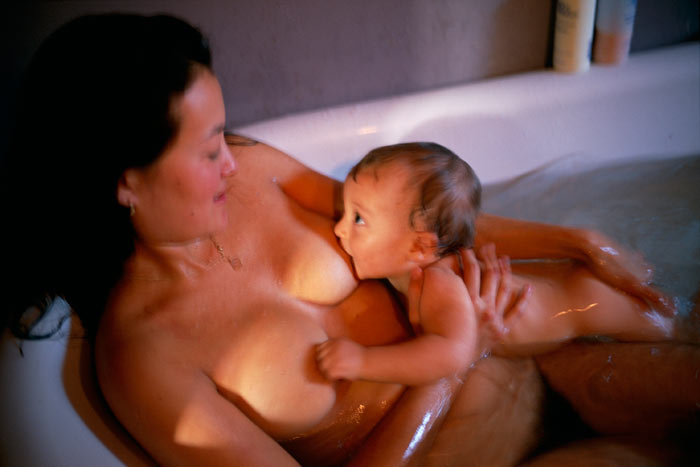
This is one of my most optimistic works: not concentrated on loss, death or darkness. With other pieces, I have wanted people to faint, throw up or cry. I've also wanted to touch them and make them laugh. Here, I don't want people to faint or throw up. But I do want them to take away something about this puritanical new witch hunt over children and their sexuality. Everybody came out of the body of a woman, and that should not be forgotten, or be frightening. It amazes me that there's a controversy over public breastfeeding, that it can be considered disgusting. Or over children running around naked, especially in the US. Children shouldn't be afraid of their own bodies; it's the worst thing you can do to a human being.


'I'm very interested in their relationships with their parents'. Photograph: Nan Goldin

The pictures are both recent and from my archive. They are all children I know: my nephew; the new twins of my friend Amanda, whom I have photographed since 1989. There are a lot of pictures of Bruno, the boy with a temporary tattoo, the son of a friend. I just found a new picture of him looking very sad, which really touches me.

Generally, they love being photographed. I never set anything up, which people find impossible to believe, but it's true. I let the children just be themselves, and try to find out who they are, then go as far as I can with that. I'm interested in how little children identify themselves by gender. I think for them it's fluid. I'm interested in the melancholy I see, and the way children retreat into their own world. I'm very interested in their relationships to their parents – whether it is obvious that they are close, or ambivalent. There is one song about an incredibly loving son who doesn't want his mother to strip: he wants to take care of her.

I like the ones where kids dress themselves up. Probably my favourite picture in the slideshow is of my goddaughter Klara, standing on a paint can singing, with scarves wrapped around her. Whenever I went to visit, she and her sister put on costumes, then did a performance for me. The child in camouflage was born a girl but chose to grow up as a boy, then changed again at 15. That little one peeping through the hole reminds me so much of myself, hiding but wanting to see. The baby on the blue pillow was about a month old, and the look that baby gave me: that kid knew everything. Some people say that children know it all and life is about forgetting, and maybe that's true. They know something we don't, because they just came out of the womb.

I wanted to show the whole process of development, so I have included babies before they were born, like my pregnant friend laughing in the bath tub. She gave birth that night, after I left, and I like the idea that the flash brought the baby out.

I don't carry my camera so much these days: I don't have the same relationship with it. I've never considered photography one of the higher art forms. Everyone takes photos; now even phones can. The whole issue of digital is so depressing to me; my process is gone. There were all kinds of unknown things that could come out in a photograph, things you didn't know were there until you saw it; now it's all so flat. But then I never really saw myself as a photographer.


'She was born a girl but chose to grow up as a boy'. Photograph: Nan Goldin

I certainly think that my work comes from a humanistic vision of the world, rather than some kind of manipulative, theoretical version of art. It's about the people and places I love, and that haunt me.